
RAPHAEL BRUNK
HUMAN DIFFUSION
JANUARY 23 - FEBRUARY 21, 2026
OPENING RECEPTION:
JANUARY 23, 2025
6 - 9 PM
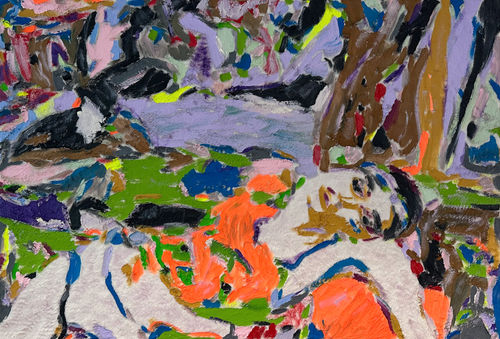
The Human Diffusion exhibition explores the question of what happens to images when they are not created by humans but by artificial intelligence – and how humans can nevertheless become part of this process again. The starting point for the works are images created using so-called diffusion models. These AI systems do not generate images by depicting reality, but by calculating probable image forms step by step from random noise. The image emerges slowly, in many small approximations. It is not a fixed result, but the outcome of constant comparison and correction. Raphael Brunk adopts this logic, but transfers it to an analog, physical process. The images generated by AI are not printed or directly transferred. Instead, they serve merely as a template. Each motif is painted entirely by hand on faux fur, but not copied, rather remembered, interpreted, and inevitably altered. The material used plays a central role in this process. The faux fur resists control: it swallows details, blurs contours, and makes precise reproduction impossible. Where AI aims for sharpness, clarity, and perfection, the material forces blurring, delay, and loss. The fur acts as an analog counterpart to digital noise—but it is unpredictable and cannot be reproduced.
This creates a form of "human diffusion": a human image-to-image process. Like AI, the original image is changed step by step. But here, the human body replaces the algorithm. Decisions, mistakes, intuition, and time are inscribed directly onto the surface. Human Diffusion is not a nostalgic return to manual labor, but a conscious choice within a technologized visual culture. Here, humans do not appear as the opposite of machines, but as a separate, unstable medium – flawed, slow, and unique. The resulting works oscillate between digital origin and material presence. Their AI-based source remains palpable, yet they elude its perfection. Traces of translation, loss, and resistance become visible. What is decisive here is not the originally generated image, but the process of its embodiment—the moment when algorithmic probability transitions into human gesture. Human Diffusion understands the image not as a finished product, but as a site of conflict: between system and subject, between machine logic and human action.
Human Diffusion marks the artist's third solo exhibition at Galerie Droste and also opens a new series of works. Raphael Brunk (*1987) lives and works in Frankfurt. He completed his studies at the Düsseldorf Art Academy as a master student of Andreas Gursky.
At the finissage of the exhibition on February 21, 2026, from 1 to 4 p.m., Galerie Droste will present Raphael Brunk's first publication entitled Digital Imaging.
You are cordially invited to join.
